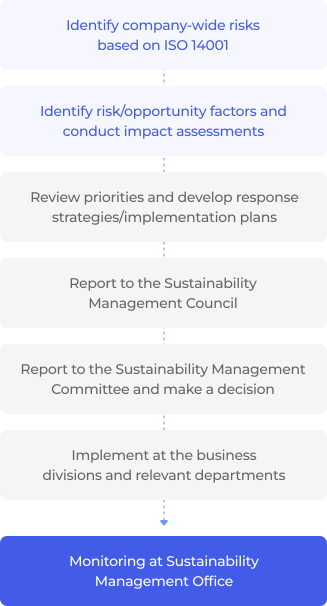
SAMSUNG SDI’s Board of Directors comprehensively manages various risks that may arise in the business environment, including operational, financial, and environmental safety risks, and makes key decisions accordingly.
We analyze climate-related risk and opportunity factors and develop response plans from the mid-to long-term perspective to effectively address the tightening global climate regulations and the needs of customers, investors and other stakeholders. Climate-related risks are categorized into transition risks and physical risks.

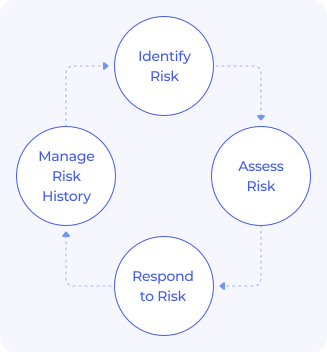
Supply chain risks include risks that may occur when partners purchase components to supply to SAMSUNG SDI as well as environmental and social risks that arise at partners themselves. SAMSUNG SDI’s purchasing risk management consists of four steps as below illustrated.

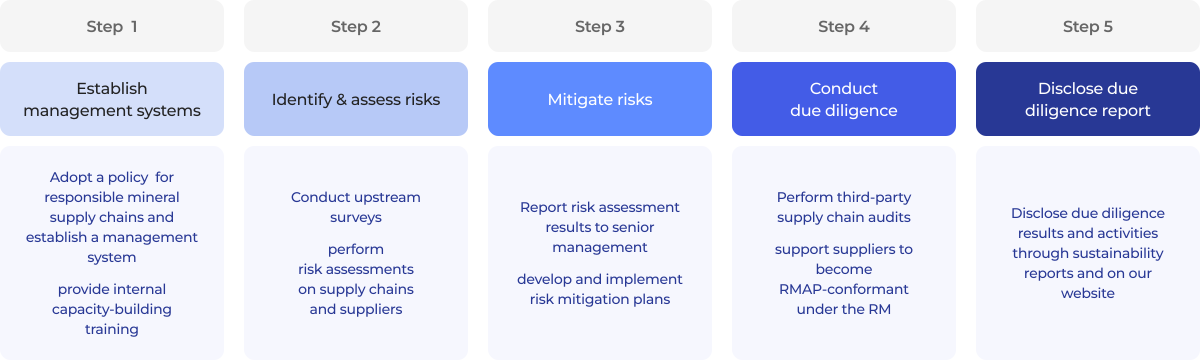
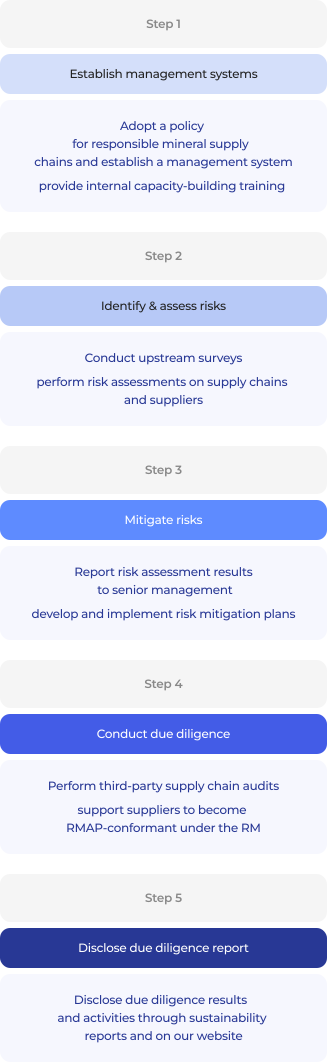
SAMSUNG SDI has established a management system based on the 5-Step Framework of the OECD Due Diligence Guidance to manage
risks along our mineral supply chains. We conduct regular surveys to ensure traceability and identify social and environmental risks in the
supply chains of key minerals. We recommend that all smelters within our supply chains obtain certification through the Responsible
Minerals Assurance Program(RMAP) of the Responsible Minerals Initiative(RMI). We also conduct audit through independent third-party
organizations for the supply chains of key minerals such as cobalt, nickel, and lithium.
When it is confirmed that a supplier, smelter, or mine is associated with risks frequently occurring in conflict-affected and high-risk areas
—such as conflict, child labor, or human rights abuses—we classify the supplier as a high-risk supplier and manage them according to
our risk response mechanism.
As a core tool of a self-disciplined prevention system, risk assessments are performed initially and then annually on a regular basis. The identified hazard/risk factors are evaluated for their risk level(intensity × frequency), then improvement/mitigation activities are implemented to reduce the risk level and prevent potential accidents. The assessment results are registered in our digital system and shared with all employees.

To prevent corruption risks in transactions with partners, SAMSUNG SDI operates a year-round monitoring system focused on
departments that directly interact with partners. When issues arise or reports are received, prompt investigations are conducted to verify
facts and take appropriate action. In addition, we conduct compliance audits on all domestic and overseas operations every four years to
assess the implementation of ethical management.
In addition, SAMSUNG SDI conducts annual compliance reviews and monitoring with a focus on high-risk departments to verify
compliance with applicable laws and contractual obligations, thereby preventing and managing potential risks in a systematic manner.
Also we carry out special reviews on key risk areas based on in-depth analysis of internal and external risk factors and environmental
changes, enabling preemptive risk management. For areas requiring year-round risk management, compliance reviews are integrated
as mandatory checkpoints in the decision-making process to prevent regulatory non-compliance from the outset.
Moreover, theme-based reviews at each compliance implementation unit and these reviews support the establishment of a self-driven
compliance culture, enabling departments to identify and correct risks at the operational level on their own.
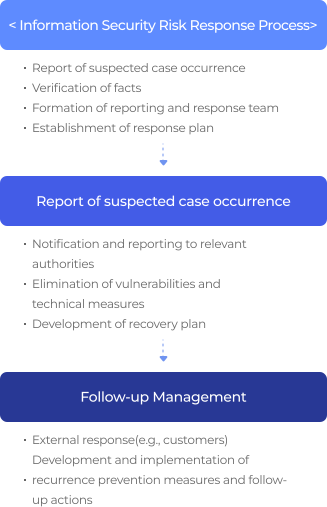
SAMSUNG SDI operates a comprehensive information security risk response framework to maintain business continuity. To ensure the availability, integrity, and confidentiality of critical information systems and data, the Company proactively identifies potential threats and disruption events and have established response processes tailored to various scenarios. In addition, the Company conducts scenario- based simulation drills on a regular basis to strengthen Company’s preparedness for actual crisis situations. Furthermore, SAMSUNG SDI operates internal reporting and whistleblowing channels, along with a rapid reporting and escalation system, enabling employees to promptly report incidents, system vulnerabilities, or suspicious activities and allowing the company to proactively manage and mitigate risks.

SAMSUNG SDI truthfully and faithfully fulfills its obligation of tax reporting and payment in countries where SAMSUNG SDI does business. SAMSUNG SDI do not use a tax structure without commercial substance for tax-avoiding purposes, nor do we engage in cross-border income transfer or tax-avoiding transactions using tax havens. At the same time, SAMSUNG SDI actively deals with changing taxation policies in various countries. To this end, all tax employees of the company perform their work according to SAMSUNG SDI’s legitimate tax strategy.
SAMSUNG SDI exerts efforts to minimize tax risks in its every business area. In all areas such as transactions of general goods, acquisition of shares, entry into a new business, international transactions, and changes in transactional structure, the company tries to identify potential unexpected tax risks and deals with identified risk factors to make improvements through the partnership with independent experts when necessary.
The management of tax risk should be open to the public and unified. For prudent tax risk management, SAMSUNG SDI has established a consistent decision-making system, offered compliance education to employees, and operated unified corporate management guidelines. From general expenses to international transactions, the company keeps and manages lawful evidential documents that each country’s taxation authorities may require. Especially, the company has maintained normal-range prices for the arm's length and related transactions.
Through the tax payment that fits the taxation policies of each country, SAMSUNG SDI contributes to the development of local communities where SAMSUNG SDI operates. The company’s corporate tax imposed on the income of the company, VATs on every transaction, and withholding taxes arising from job-creation have a positive influence on the growth of local communities.
SAMSUNG SDI Co.,Ltd, as a global company, hereby declares that it shall strictly recognize the importance of strategic items export management to contribute to international security and sustainable management through the following principles.
First,
all our executives and employees shall strongly recognize that complying with export control of strategic items is critical to fulfilling our corporate responsibility for the promotion of international security and world peace and shall endeavor to share this.
Second,
all our executives and employees shall actively strive to establish the necessary organizations and systems within the company to manage the strategic items autonomously, and all organizations of the company shall actively cooperate for the efficient and systematic operation of the autonomous export management organization.
Third,
all our executives and employees shall actively cooperate with the government’s policy on export control of strategic items and do our utmost to prevent any violations of the Foreign Trade Act including the illegal export of strategic items.
SAMSUNG SDI Co., Ltd.
Joo Sun Choi, CEO